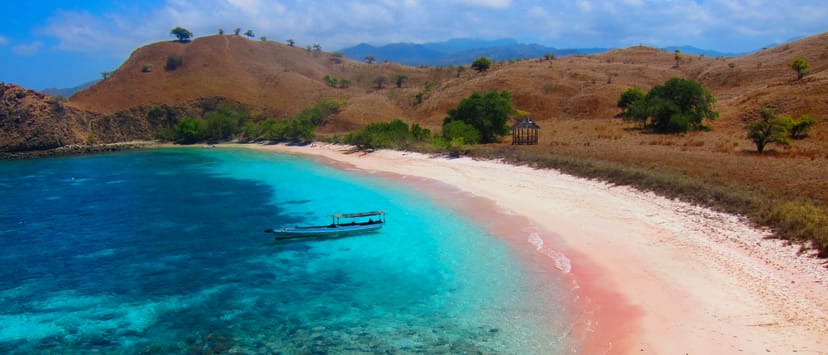
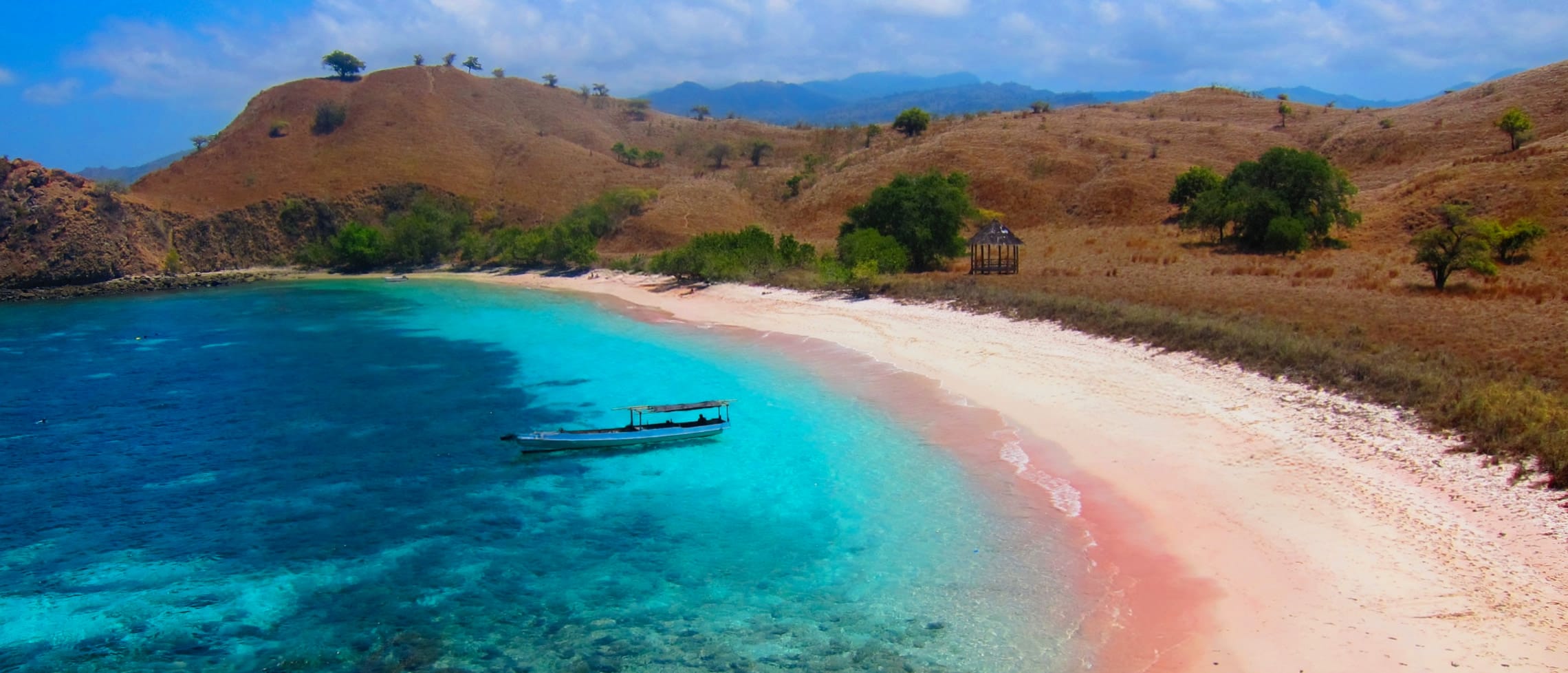
The photos have been everywhere for years. A crescent of sand somewhere between coral and rose, backed by dry savanna hills, and surrounded by crystal clear turquoise water. Most people who see them online wanted to go and experience it in person.
Pink Beach, known locally as Pantai Merah or "Red Beach" is real. The color is real. However, to experience it in the best conditions or to your preference may require a planning. This guide covers everything that matters, from why the sand is pink to the 2026 visitor quota and what it means for planning your visit.
What Is Pink Beach in Komodo National Park?

Courtesy Jonne Seijdel
Pantai Merah sits on the southeastern coast of Komodo Island, nestled in a curved cove backed by dry savanna hills. This sheltered location keeps the water calm on days when other park locations are choppy, which is a big part of why snorkeling here is consistently good.
The beach runs approximately 200 meters, a compact and intimate cove rather than the sweeping stretch shown by most drone shots. Komodo National Park is a UNESCO World Heritage Site spanning three major islands and some of the richest reef diversity in the world, and Pink Beach is one of its most visited points.
One thing that catches many first-time visitors off guard is that there is no dock around. You will anchor offshore and either wade in or take a small boat to shore. It is the only way for you to reach the beach.
Why Is the Sand Pink? The Science Behind the Color

Courtesy Pramod Kanakath
Why is the sand pink at Pink Beach Komodo?
The pink comes from Homotrema rubrum, a bright-red encrusting foraminifera that grows on reef surfaces and breaks down into fine shell fragments when it dies. Those fragments wash into the cove and mix with white calcium carbonate sand, gradually shifting the color from white toward rose. Crushed red coral, which you may have seen, plays a supporting role in the same sediment mix. The foraminifera on the living reef keep replenishing that material, which is why reef health and beach color are directly connected.
Is Pink Beach really pink?
Yes, but it shifts more than most photos suggest. Wetness, light angle, and tide all affect how the color shows. The most vivid color shows up early morning 8 to 10 AM, and late afternoon from 3 to 5 PM. Midday light flattens it, though the pink remains visible, just less saturated. You will also find its strongest pink at the shoreline during low tide as the wave-wash zone drops lower.
Just keep in mind that many images travelers arrive with show the beach at its most favorable conditions, often with the saturation pushed up a notch.
Pantai Merah vs. Long Beach: Which Pink Beach Should You Visit?

Courtesy asnidamarwani (Left - Pantai Merah Komodo) & Devagonal (Right - Long Beach Padar)
Komodo National Park has more than one pink beach, and the two are genuinely different experiences. Pantai Merah on Komodo Island is the more widely known of the two, with Long Beach sitting on Padar Island. Both are worth visiting, and knowing what each offers best helps you make the most of each stop.
Pantai Merah has a brighter, more saturated pink, nearly coral-red at the waterline, with reefs starting just offshore. The snorkeling here is the stronger of the two, with clownfish, parrotfish, and the kind of reef density that rewards you for getting in the water early. Visiting Pantai Merah typically pairs with a Komodo dragon trek on the same island, making it a natural anchor for a full day in the park.
Long Beach sits at the base of Padar Island's famous three-bay ridgeline, and most visitors reach it by descending after the ridge hike. The pink here is softer and more pastel, lending itself more to landscape photography than close-up appreciation. Many people do not make it all the way down to the beach after the climb, so those who do tend to find it quieter than they expected.
How to Get to Pink Beach from Labuan Bajo?
The routing from the US is longer than most first-time visitors expect. The most common routing is through Bali, connecting onward to Labuan Bajo's Komodo Airport (LBJ), approximately 1 hour to 1 hour 15 minutes by direct domestic flight. Build in a full day buffer in Bali for your connection to Labuan Bajo. A missed boat departure in Labuan Bajo can mean waiting for the next available slot.
From Labuan Bajo harbor, Pink Beach is roughly 1 to 1.5 hours by speedboat or 2 to 3 hours by traditional phinisi, depending on conditions and stops along the way. The passage runs through the Lintah Strait, and on a calm dry-season day it is one of the more scenic stretches of water in Indonesia, with volcanic mountains in silhouette and hillsides shifting from gold to green. During the wet season (November through March), the crossing can get rough and uncomfortable, especially for those prone to seasickness.

Courtesy Phion Ethan
How You Visit Matters More Than You Think
The format you choose shapes your Pink Beach experience more than almost anything else about the trip. There are three ways to do it: a day trip returning to Labuan Bajo each evening, a liveaboard sleeping on the water inside the park, or a private charter which can be either. The distinction that actually matters it is whether you sleep on it.
Day trips, shared or privately chartered, follow the same rhythm out of Labuan Bajo. They typically reach Pink Beach mid-morning, which is when most other boats arrive too. You still get the beach, but you get it at its busiest. Getting there before the crowd is not something a day trip can promise.
A liveaboard changes that entirely. Guests sleep aboard a traditional phinisi anchored inside the park and wake up on the water, sometimes within swimming distance of the beach itself. By the time the first day-trip boats arrive from Labuan Bajo, liveaboard guests have already had the beach to themselves. That early window is what makes the experience feel even more special.
What to Do at Pink Beach
Snorkeling. The reef starts just around the shoreline, with clownfish and parrotfish reliably present. If you're lucky enough, you may also encounter small reef sharks and giant clams. Head to the southern end of the beach before getting in, where there is usually less boat traffic and healthier reefs than near the main landing area.
Hillside viewpoint. An unmarked trail toward the southern end of the beach climbs around 10 to 15 minutes to a ridge with a full overhead view of the cove. Nothing points to it, so many visitors miss the panoramic pink beach stretches entirely.
The beach itself. The far southern end of the cove, away from the main boat landing, is almost always quieter. The water is calm, and the sand shows its strongest pink tones in the softer light of morning and late afternoon. After coming all this way, take some time to simply enjoy the moment.
There are also no facilities on shore. No toilets, no shade, no fresh water, no food. So you will have to pack everything essentials from the boat for a comfortable visit. You may also be approached by small boats offering souvenirs on your way here, though prices are usually higher than in Labuan Bajo.

Courtesy Pnnchen
The 2026 Visitor Quota: What It Means for Your Trip
As of April 1, 2026, Komodo National Park caps visitors at 1,000 per day across all zones. Divers, snorkelers, beach visitors, and trekkers all draw from the same daily allocation. It is not limited to trekking areas, as many travelers still assume. Once the daily allocation is full, no further permits are issued for that date.
Permits are booked through the SiOra app, Indonesia's national park reservation system. Passport details are required, and permits are non-refundable once issued. The app accepts Indonesian bank transfers and select digital wallets. International credit card payments are not yet available, which means most international travelers cannot complete the booking process independently. Peak season (June through September) fills fastest, sometimes weeks out, making operator-assisted booking the most practical solution for anyone planning ahead.
How much does it cost to visit Komodo National Park?
For snorkelers and beach visitors, the entry fee is IDR275,000 per person/ day, covering the marine park ticket and harbour fee. Meanwhile, divers pay an additional fee of IDR25,000 and brings the total to IDR300,000. The fee is fixed, but securing the permit slot requires planning ahead.
Best Time to Visit Pink Beach

Courtesy Petr Tran
The dry season runs April through October. May, June, and September hit the sweet spot, with excellent snorkeling visibility and fewer crowds than July and August. April is worth considering. The landscape is still green from the tail end of the wet season, visitor numbers are just starting to increase, and quota slots are easier to secure.
July and August have the largest crowds, driven by Indonesian school holidays overlapping with summer travel. Quota slots fill fastest in this window. October is transitional, still generally fine, but swells start building in some channels by the end of the month. November can already bring rough conditions on certain crossings, and by December the wet season is reliably in effect.
The wet season (November through March) is doable, but there are some tradeoffs. Boat rides get rougher, snorkeling visibility drops, and the flat overcast light makes the sand look far more pale than what most photographs show.
Tips for Visiting Responsibly
The pink sand depends on a healthy reef, and visitors may have a bigger impact than they realize. Keeping it this way is something every visitor plays a part in. Here are several tips to help visit Pink Beach responsibly:
Use reef-safe sunscreen. Pack your own before you travel, as options may be limited in Labuan Bajo. Standard sunscreens may contain oxybenzone, which causes coral bleaching damage.
Leave the sand alone. Taking any sand, shells, or coral fragments from Komodo National Park is illegal under Indonesian law. Help preserve what you came to see.
Do not touch the reef. Coral grows a centimeter a year and has no way to recover what a single wrong touch destroys. Gloves and reef hooks are not permitted, as both make touching the reef more likely, not safer.
Know the drone rules before you arrive. Flying a drone at Pantai Merah requires a SIMAKSI permit and a paid drone operation ticket, arranged in advance through siora.id. Rangers are authorised to act on unregistered drone use under park regulations.
Pack out everything you bring in. There are no bins at the beach, so anything you carry in needs to leave with you.
Planning Your Visit
Pantai Merah rewards the travelers who plan it carefully before they arrive. The color, the snorkeling, the quiet at the southern end of the cove early in the morning are not accidental. They all come from arriving at the right time, in the right format, with the right expectations. Most travelers who visit want to come back. The ones who do not are usually the ones who arrived at noon and left feeling it did not quite live up to the photos.
If you need help planning your Pink Beach and Komodo itinerary, speak with our specialist. Let us handle the details so you can focus on the trip itself.